Character Descriptions That Tell You What to Expect
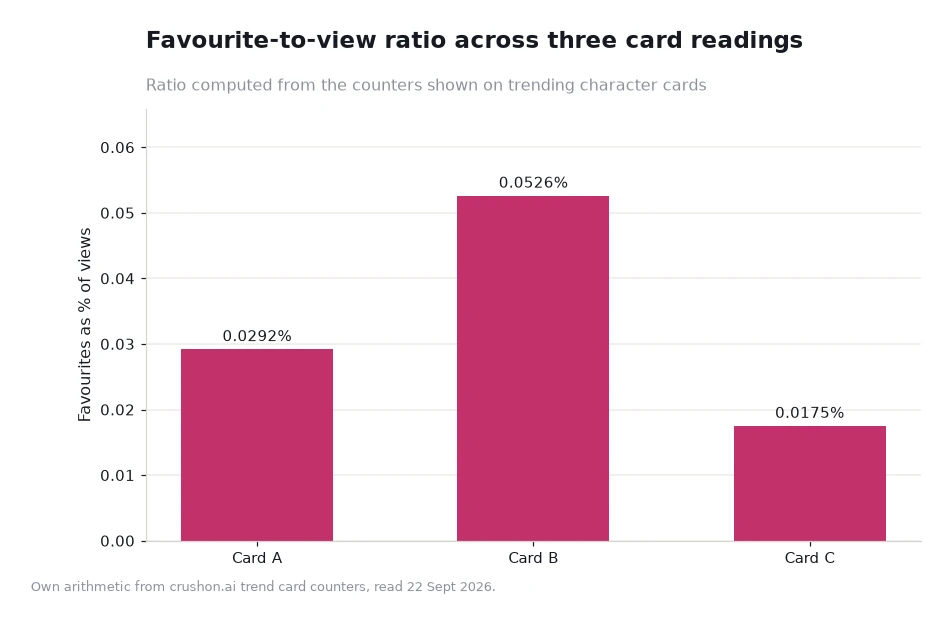
A character description is the closest thing an AI chat catalogue has to a preview, and it does three jobs at once: it sets the premise, names the tone, and quietly states the boundary. Read three hundred characters on the Crushon list and the pattern becomes obvious — the cards that hold attention are the ones whose description matches the session the reader wanted. The numbers agree: on one dated reading the cards saved at 0.0526% and 0.0175% of views were three times apart, while their descriptions looked almost equally inviting at a glance.

Key takeaways
- Read a description for three things in order: the premise, the tone, and the one line that tells you where the character will not go.
- A description that promises everything promises nothing; the narrower cards are easier to match to a session.
- Use tags as shorthand and the creator's own sentences as evidence — the two together beat either one alone.
- Cross-check with counters last: a three-fold gap in favourites per view does not correspond to a three-fold gap in quality.
The three jobs a description does
The first job is the premise. Somewhere in the opening lines there should be a situation: who the character is, where the conversation is happening, and what the two of you are nominally doing there. A card that provides a premise gives the conversation a first move without you having to invent one.
The second job is tone. A description written in clipped, funny sentences is announcing a different register from one written in dense paragraphs about a character's history. That is not decoration; it is the creator showing you the voice they built the character to speak in, and it is the single best predictor available before you type a word.
The third job is the boundary, and it is usually the shortest part. Some descriptions state plainly what kind of interaction the character is built for. That line is a gift, because it lets you rule a card out in five seconds rather than discovering the mismatch ten minutes into a session.
Description patterns and what each one signals
Once you know the three jobs, the patterns are easy to spot. Below are six that recur across the catalogue, with what each one tends to signal and what it leaves unstated.
| Pattern | What it signals | What it leaves open |
|---|---|---|
| A stated situation in the first line | The creator has thought about how a conversation begins | Whether the situation holds up past the opening |
| Long backstory before any interaction cue | Emphasis on narrative and setting | Whether the character can handle short, light exchanges |
| Clipped, comic phrasing | A playful default register | Whether a serious session will be supported |
| A dense tag strip with several labels | An attempt to cover multiple audiences at once | Which of those tags the creator actually built for |
| The Unfiltered label present | The card sits in the unfiltered catalogue slice | Nothing about tone: unfiltered is a catalogue label, not a style |
| A one-line description with nothing else | Either a new card or a deliberately minimal pitch | Almost everything, which is why it is worth opening before saving |
The fourth row is a warning rather than a recommendation. A tag strip that lists six labels is describing six possible readers, and the description itself is what tells you which one the creator had in mind. Read the sentences, then use the tags to confirm what you already concluded.
Worked example: matching a description to a counter
Here is a short exercise. Take the three readings on the chart: 0.0292%, 0.0526% and 0.0175% favourites per view. Divide the largest by the smallest and you get 0.0526 / 0.0175 = 3.0, so the best of the three earned three times as many saves per view as the weakest. Divide the smallest by the middle one and you get 0.0175 / 0.0292 = 0.6, meaning the weakest card still earns sixty per cent of the middle card's rate.
Now do the qualitative version on the same three cards. Open each description and ask the three questions: is there a premise, what tone is the prose written in, and is the boundary stated? In practice, the card with the strongest ratio usually answers all three clearly, and the weakest usually answers one and gestures at the rest.
The point of running both is not to produce a score. It is to notice that a three-to-one gap on the counter side corresponds to something legible on the description side, and that reading descriptions is a way of predicting the counter reading before you ever look at the numbers. The ratios quoted here are the author's arithmetic on the counters displayed on the cards on 22 Sept 2026, not published platform statistics.
From description to decision
The reading sequence that works is short. Filter the catalogue, read descriptions on the first six cards, and shortlist two. Then check the counters on those two only. Descriptions first means the numbers are confirming a choice rather than making one, which is the order that tends to produce characters you keep. A reader who searches for nsfw ai options and sorts purely by rank is running that sequence backwards.
Two habits sharpen the reading. First, note the register the description is written in and open with a matching line, because a card built for dense narrative will feel different from one built for banter. Second, treat the tag strip as confirmation, not as a shopping list; the platform's own descriptions of its NSFW AI characters make the same point, that framing is set by the creator and the session is set by you.
Finally, keep a note of the descriptions that worked. A short list of phrases that predicted a good session is worth more than any ranking, because it is the one filter that is calibrated to your taste rather than to everyone's. The AI chat blog is a reasonable companion read while that list is short.
Frequently asked questions
What should I read first in a character description?
The opening situation. If the first line establishes where the conversation is happening and who is present, the creator has given the session somewhere to start, which matters more than the length of the rest of the text.
Do longer descriptions mean better characters?
Not necessarily, though they usually signal an emphasis on narrative. A long backstory is useful if you want a story and a hindrance if you want a quick exchange, so length is a register clue rather than a quality score.
How do tags relate to the description?
They are shorthand. Use them to narrow a list, then read the sentences to find out which of the tagged possibilities the creator actually built. When the two disagree, trust the description.
Can a description predict how often a card gets saved?
Only loosely. A clear premise and a consistent tone tend to travel well, but the ratio on the card also reflects how much traffic the card receives, which is a matter of placement as much as quality.
Read descriptions like a reviewer, not a shopper
Try it on your next visit: six descriptions, two shortlisted, counters checked last. The whole pass takes under ten minutes and produces a better first session than scrolling a ranked grid.
Then write down the one phrase that made the difference. Over a few weeks you will have a personal filter stronger than any published list.
Data and sources: character descriptions, tag strips and the counters displayed on the trends page of Crushon.AI, read 22 Sept 2026[1]. Ratios are the author's own arithmetic on those displayed counters. This article is written for readers who are 18 or older.