How a 23-Year Brewing Equipment Manufacturer Works With New Breweries
Twenty-three years of craft brewing equipment design and successful sales in more than seventy countries is the published record of Hermann Biological Engineering in Jinan, China. For a first-time owner the useful question is not the age of the company but the sequence of a project: what happens first, what the buyer must supply, and what arrives on site. This guide follows that sequence from business plan to first brew.
Key takeaways
- 23 years of design work, with turnkey delivery described by the company as from A to Z, meaning the business plan through to the first brew.
- Five inspection steps on every shipment, plus a data plate on each tank recording its pressure test and serial number.
- The published warranty is 6 years on tank accessories and electronic components against manufacturing defects from the factory, used within scope.
- Delivery is quoted at 90-150 days from deposit to door, so a taproom opening date has to be built around that window.
What two decades of brewery building actually change
Experience shows up in the first design meeting rather than in a catalogue. A builder that has shipped systems to over seventy countries, including the United States, Canada, Mexico, Brazil, France, the Netherlands, Kazakhstan, Singapore and the Nordic countries, has already met most of the awkward constraints a new plant will present: narrow doorways, a three-phase supply that is smaller than hoped, low ceilings and neighbours who care about noise.
That accumulated detail is the real product. It is the difference between a quote that lists vessels and a quote that also tells you what the floor drain has to do, how much headroom the grist case needs, and which parts of the plan can wait until year two.
The published service range also reaches past the equipment itself. It includes a whole business plan worked out from scratch, with design proposals customised to the customer's requirements and budget, and technical support through installation. For a founder with a beer recipe and a lease but no spreadsheet, that is the difference between a good idea and a financed project.
From business plan to first brew: the working sequence
A brewery project fails at the seams, not in the middle. The stages below are the published shape of a turnkey order, and each one has an owner and a document attached to it.
- Business plan and beer list: the styles, the expected monthly volume and the package formats that the plan has to support.
- Design proposal: vessel sizes, plant layout, utility loads and a budget band drawn around the requirements.
- Order and deposit: the published delivery clock of 90-150 days starts running here.
- Fabrication and testing: five inspection steps, with the inspection record travelling alongside the order.
- Shipping, installation and commissioning: wooden-box packing, a checking list inside the shipment, and technical support once the crates are open.
Note where the risk sits. Steps one and two cost the buyer nothing but time, and they are the only stages where a bad decision is still cheap to correct. Moving a 2,000 litre vessel that was ordered to fit a doorway it cannot pass through is not a paperwork problem.
Quality control: five inspection steps and one data plate per tank
Every shipment is described as passing five inspection steps: materials checking, production process control, jacket pressure testing, equipment packing and loading inspection, and a finished-product leak test. The record of those checks travels with the order, which is the document to keep for the day an insurer, a landlord or a food-safety auditor asks how the vessels were proved.
Each tank also carries a data plate with its pressure-testing record and serial number. A serial number looks like a formality until you add a fourth fermenter three years later and want a vessel that matches the pipework, the glycol loop and the control cabinet already on the floor.
Packing is in wooden boxes, and the shipment includes a checking list. Counting the goods against that list before signing the delivery note is the best-spent half hour in the whole project; it is also the only moment when a shortfall is unambiguously someone else's problem.
| Element | Published arrangement |
|---|---|
| Business plan | Covered by the service range, described as business plan through to brew |
| Design | Customised proposals matched to requirements and budget |
| Vessel sizes | Published range from a 200 L nano set up to 10,000 L (10 T) |
| Testing | Five inspection steps per shipment; record travels with the order |
| Site work | Installation, commissioning and full technical support |
What a 10 BBL reference project looks like in published numbers
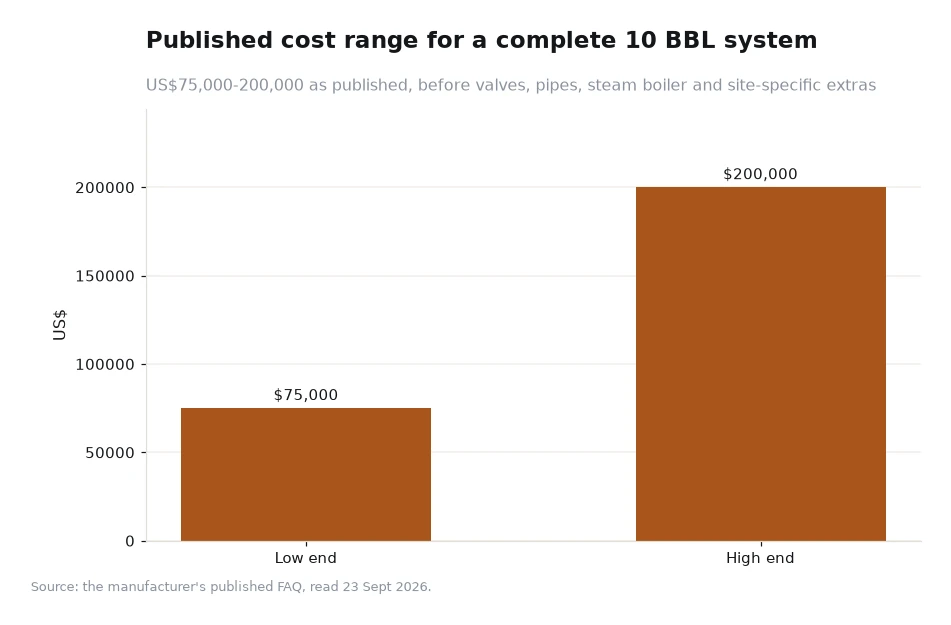
Cost is the first question every founder asks and the hardest to answer in advance. The manufacturer publishes one datapoint for a complete 10 BBL beer equipment system: around US$75,000 to US$200,000. The same page is explicit that valves, pipes, a steam boiler and other requirements move that figure, so the range behaves as a starting band rather than a quotation.
A 10 BBL batch is roughly 1,170 litres, using the working conversion of 1 BBL to about 117 litres. Everything else in a brewery plan scales from the batch size: the number of fermenters, the size of the hot liquor tank, the glycol load and the floor space in front of the filler.
Worked example: a 1,000 litre start under a 10 BBL budget band
The arithmetic below is an example, not a quotation, and every assumption is stated. Assume a 1,000 litre brewhouse running 10 brews a month, with 8 per cent of each batch lost to trub, yeast and packaging. Gross production is 1,000 multiplied by 10, which is 10,000 litres a month. Applied losses of 8 per cent remove 800 litres, leaving 9,200 litres of saleable beer a month, or 110,400 litres over twelve months.
Now take the published capital range and treat it as the spend for this planning sketch: US$75,000 at the low end and US$200,000 at the high end. Spread over the first four months of gross production, which is 40,000 litres, the low end works out at US$1.88 per litre and the high end at US$5.00 per litre. The gap between the two, US$125,000, is the part of the budget that valves, piping, steam generation and site-specific works decide.
The same arithmetic run over a full year of 110,400 saleable litres gives US$0.68 per litre at the low end and US$1.81 per litre at the high end. The lesson is not the number itself; it is that the denominator grows every month while the capital figure is paid once, which is why brews per month matters more than any single equipment choice in the first year.
Frequently asked questions
How long does a brewery equipment order take to arrive?
The published lead time is from deposit to door delivery, 90-150 days depending on the order. The vessels are rarely the constraint in that window: site utilities, floor drainage, packaging decisions and permits usually decide whether the date holds, so those should be settled while fabrication is running.
What does the warranty cover on new vessels?
The company publishes 6 years of warranty on tank accessories and electronic components against manufacturing defects from the factory, provided the parts are used within scope. Sales staff and engineers are described as online 24 hours, with 7x24 after-sales service covering installation questions and spare parts.
How to open the conversation with a supplier
Bring four things to a first meeting: the beer list, a floor plan with ceiling heights, the electrical supply, and a monthly volume you are prepared to defend. Those four inputs let a designer produce a customised proposal instead of a generic catalogue page, and they usually shorten the design stage by weeks. It also helps to walk in having read the supplier's own company profile and its brewery equipment range, so the discussion starts at the right level.
It also pays to ask for the paperwork rather than the promises: the inspection record that travels with the order, the data plate details for each vessel, the warranty document and the packing list. A supplier that answers those questions without hesitation is a supplier you can plan a building around. If you want to see how hem brewing frames a first project, its published material covers the same sequence from business plan to installation, and the contact page lists the sales and engineering desk in Jinan for follow-up questions.
Figures in this article come from the manufacturer's own website, read 23 Sept 2026: the 10 BBL cost range, the five inspection steps per shipment, the 6-year component warranty and the 90-150 day delivery window. Conversions to litres and cost-per-litre figures are this article's own arithmetic and are labelled as examples. Details: [1]