When Minimum Standards Are Not Enough in Desert Heat
A cable that meets EN 50618, IEC 62930 and TUV 2PfG 1169/08.2007 has cleared the minimum bar, and a desert site asks more of it: sustained ambient near the published +90 °C ceiling, months of intense ultraviolet, ozone and repeated thermal cycling between a cold night and a hot afternoon. The published figures from KUKA CABLE show where the margin sits — a 2,000-hour xenon lamp run described as about 360 weathering cycles, and elongation up to 185% against a 125% requirement.
Key takeaways
- Ambient limit published for the 6 mm² build is +90 °C, with a −40 °C floor at the cold end.
- Short-circuit ratings are +120 °C held for 20,000 hours and +250 °C for 5 s.
- Ageing evidence: a 2,000-hour xenon lamp run, equal on the site's wording to about 360 weathering cycles.
- Stranding in the published size table runs from 56 strands of 0.29 mm at 4 mm² to 142 at 10 mm², a class 5 flexible conductor to IEC 60228.
What the standard sets, and what heat adds
A PV cable standard fixes test levels, not service conditions. EN 50618 requires more than 125% elongation before ageing; IEC 62930 describes PV cable construction and testing; TUV 2PfG 1169/08.2007 is the certification route the client names for its solar range. All three are floors. A desert array then applies its own load: ultraviolet that arrives every day, a surface that stays hot long after the air cools, and daily movement as conductors expand and contract.
The useful way to read a datasheet in that setting is to compare published limits with measured site values. The manufacturer publishes the limits; the site survey provides the other column. Where the two are close, the margin has to come from the material, the stranding or the installation method, and each of those is documented somewhere on the product pages.
The thermal numbers to compare against a site
The comparison a designer makes in the field is between the site and the cable window the manufacturer publishes. For the 6 mm² construction that window opens at −40 °C and closes at +90 °C in normal service. Fault conditions are covered on their own lines: +120 °C sustained for as long as 20,000 hours, and +250 °C for a 5-second event. The electrical ratings sit beside them — DC 1.8/1.8 kV, a production spark test at 10 kV, and 6.5 kV AC at 50 Hz held for 5 minutes on the finished cable.
The +90 °C ambient maximum is the number a desert designer checks first, because it is the one a hot roof can approach without any fault at all. Nothing in the published material states a roof surface temperature for any location, so that comparison is a site measurement rather than a datasheet fact. What the sheet does confirm is the material: cross-linked XLPO insulation and sheath, both LSHF, which is the version of the polymer that resists flow at temperature.
Why fine stranding matters in a hot climate
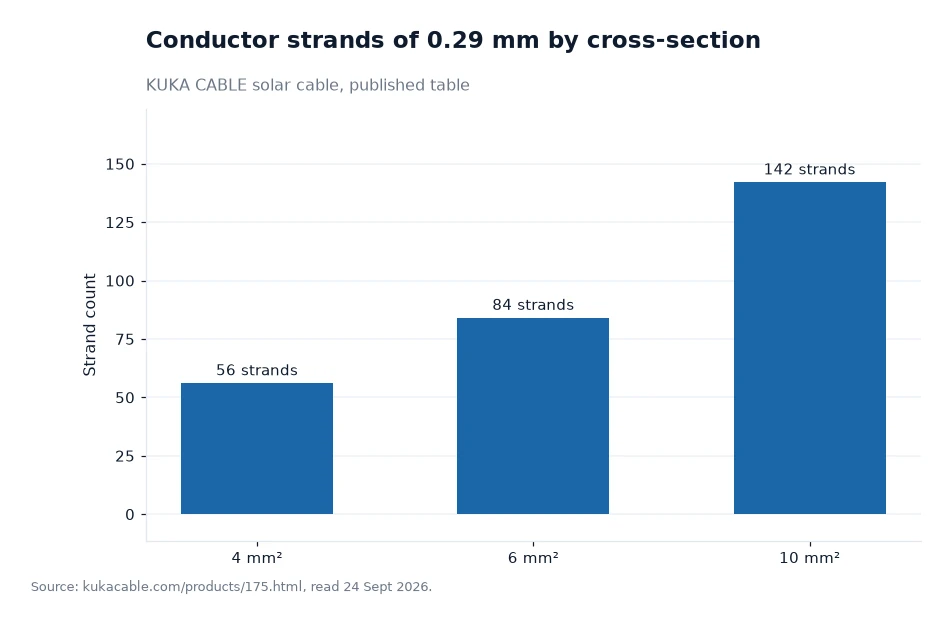
The conductor is tinned copper, class 5 flexible to IEC 60228, and the published table shows what that means at each size: 56 strands of 0.29 mm at 4 mm², 84 at 6 mm² and 142 at 10 mm², rising through 238 strands at 16 mm² to 1,968 strands at 240 mm². Dividing 142 by 56 gives about 2.5 times as many strands in the 10 mm² construction as in the 4 mm² one, which is my own comparison.
Strand count is not a published durability claim, and it should not be read as one. It is a description of flexibility. Many fine strands let a conductor follow a route and absorb daily movement without transferring the strain to one thick wire, and tinning keeps the individual strands from oxidising where moisture reaches them. Both properties help in a climate with a large day-to-night temperature swing. The same conductor design runs through the solar pv cable family, so comparing two sizes is a comparison of strand counts and diameters rather than of compound.
Ageing evidence that speaks to sunlight
The test most relevant to a desert installation is the 2,000-hour xenon lamp run, presented on the site as equal to about 360 weathering cycles and as a simulation of intense sunlight, humidity and ozone. It is being arranged on the manufacturer's PV cable range, which is worth reading exactly as written: a programme under way rather than a finished result for every size.
Elongation is the companion figure. Measured elongation for the compound is published as high as 185%, against a standard that asks for more than 125%, and the site attributes the gap to a compound that goes beyond the UV stability the TUV benchmark demands. On a hot roof, a polymer that keeps its stretch keeps its resistance to the surface cracking that starts small and ends in an earth fault.
What the site does not publish
No site temperature data, no per-location UV dose, no warranty term, no price and no minimum order quantity appear on the site. Nor does it publish a pull-tension figure or a test result for every cross-section. Those absences are not unusual, and they are all answerable in a purchase order: state the site's highest measured surface temperature, the expected daily swing and the installation method, and ask for the ageing report and the certificate for the size on order.
| Property | Published limit | Why desert heat tests it |
|---|---|---|
| Ambient range | −40 °C to +90 °C | roof surfaces approach the upper bound |
| Short circuit, long | +120 °C for 20,000 hours | sustained overload raises insulation temperature |
| Short circuit, brief | +250 °C for 5 s | fault current in a hot conductor |
| Elongation | up to 185% against a 125% floor | daily movement without cracking |
| UV and ozone | 2,000-hour xenon run, about 360 cycles | unshaded all-day radiation |
| Flame behaviour | 800 °C vertical burn, one minute | dry vegetation and mounting debris |
Worked example
The chart here is the manufacturer's strand count by cross-section, which is a flexibility figure rather than a heat figure, and it is presented as such. Its title is "Conductor strands of 0.29 mm by cross-section", with bars of 56, 84 and 142 strands for 4 mm², 6 mm² and 10 mm², from kukacable.com/products/175.html. Two calculations of mine sit on top of the published numbers: 2,000 hours divided by 360 cycles gives about 5.6 hours per cycle of simulated weathering, and subtracting the +90 °C ambient maximum from the +250 °C short-circuit rating leaves 160 °C of headroom for a fault event. The first number shows how compressed the ageing test is; the second shows why a fault is a thermal event and not just an electrical one.
Frequently asked questions
Is a +90 °C ambient limit enough for a desert site?
It depends on the measured surface temperature, which the site does not publish for any location. The +90 °C figure is the maximum the 6 mm² construction is rated for in normal service, and a hot roof can approach it without any fault occurring. Measure the surface at the hottest hour, compare it with the limit, and ask the supplier to confirm the sizing in writing.
Which published test best represents desert exposure?
The 2,000-hour xenon lamp run, described by the manufacturer as about 360 weathering cycles and as a combination of intense sunlight, humidity and ozone. It targets insulation integrity under radiation rather than temperature alone. Pair it with the elongation figure of up to 185% for the same compound, since a material that keeps its stretch is less likely to crack under daily cycling.
What to do before specifying for a hot site
Measure the surface temperature at the worst hour and record the day-to-night swing, then compare both against the published −40 °C to +90 °C range. Request the ageing report, the elongation result and the certificate covering the size on order, and state the installation method so the bending rule of 4 × diameter can be applied on site. Where a route runs across an exposed roof, consider whether a lighter cross-section with shorter runs is preferable to a heavy cable under full sun. The published figures are the starting point for that decision, and the cross-section data gives the per-size numbers to work from.
Desert-heat suitability rests on figures from the manufacturer's own website, kukacable.com, surveyed 24 Sept 2026[1].